
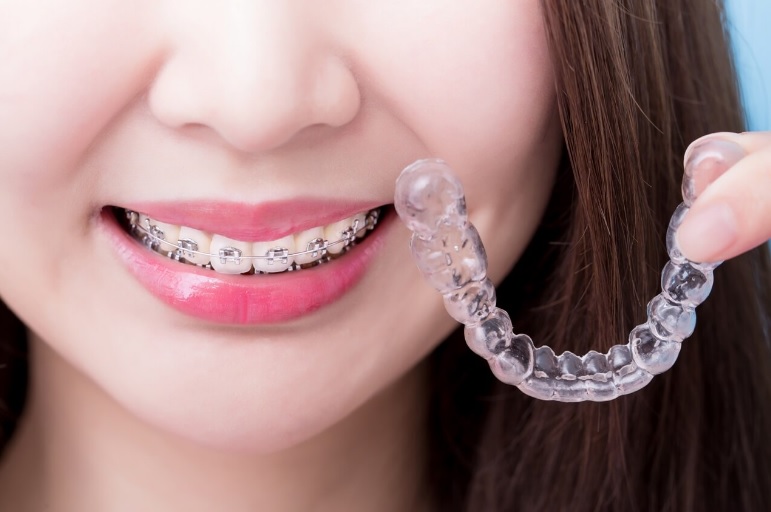
Orthodontic appliances have changed over the years. Patients considering orthodontic treatment in North Sydney may have a choice between fixed braces and clear aligners such as Invisalign, depending on what their clinical assessment shows. This article compares Invisalign vs braces costs and the factors behind them.
Comparing the cost in Sydney
Published price guides for Sydney commonly put fixed braces in the range of $8,000 to $15,000 and clear aligner treatment in the range of $7,000 to $9,000. These are indicative figures from published sources, not quotes, and they vary widely between practices and between cases. The fee for your case can only be determined after an examination and treatment planning.
Fees at North Sydney Dentistry
Clear aligner treatment is available with a payment plan from $25 per week. That is a repayment amount, not the total fee.
Fixed braces are provided at our other practices, Sydney CBD Dentistry, Hornsby Dental and North Ryde Dentistry. Fees start from $4,500 and range to $6,000 or more depending on the complexity of the case.
Which is more expensive?
Neither appliance is consistently cheaper. Clear aligners are often quoted at a higher fee than fixed braces for straightforward cases, but a complex case treated with fixed braces over a longer period can cost more than aligner treatment. The relevant comparison is between the two treatment plans proposed for your case, not between the appliance types in general.
Practical differences
Clear aligners are less visible than metal brackets and wires, though they are not invisible and the attachments bonded to teeth can be seen at close range. Aligners are removable, so there are fewer restrictions on food and drink, and cleaning teeth is more straightforward.
Fixed braces are not removable, which means treatment does not depend on the patient remembering to wear the appliance. They do require avoiding hard and sticky foods, and cleaning around brackets takes more effort.
Which works better?
Effectiveness depends on the case rather than on which appliance is generally “better”. Clear aligners rely on the patient wearing them 20 to 22 hours a day. Where they are not worn as directed, treatment slows or the planned tooth movement does not occur. Aligners can also be misplaced, and replacements are charged.
Some tooth movements and more complex bite corrections are more predictably achieved with fixed appliances. Clear aligners are not suitable for every case. Your dentist will explain which options are appropriate for you and why.
Risks
Both treatments carry risks, including discomfort and tooth sensitivity, irritation of the gums and soft tissues, decalcification and decay where oral hygiene is not maintained, shortening of tooth roots, gum recession and relapse if retainers are not worn after treatment. Treatment may take longer than estimated and some cases need additional procedures.
These risks should be explained to you in full, and you should receive a written quote, before you agree to treatment.