
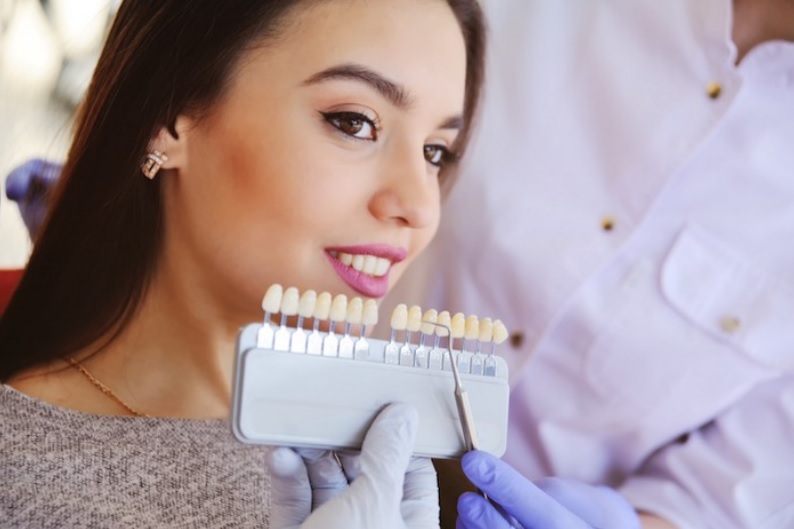
When considering veneers, the material affects durability, appearance and cost, both at the time of treatment and over the years that follow. The two options are porcelain and composite resin. This article compares them and sets out what to weigh before deciding.
Porcelain compared with Composite
Porcelain veneers are made in a dental laboratory from a ceramic material. Published estimates commonly put their lifespan at around 10 to 15 years. Composite veneers are built up directly on the tooth from resin and are commonly estimated at around 4 to 8 years.
Both figures vary considerably with the individual, the bite, oral hygiene and habits such as grinding, and some fail earlier. Neither material is permanent, and both will need replacing.
Porcelain resists staining and wear better than composite. Composite can usually be repaired or added to, while a damaged porcelain veneer generally has to be replaced. Composite typically requires less enamel removal and costs less per tooth.
Which material is appropriate depends on your teeth, your bite, how much enamel is available and what you want to change. That is a clinical judgement made after examination rather than a straightforward matter of paying more for a better result.
IMPORTANT — most veneer treatment involves permanently removing a layer of enamel from the front of otherwise healthy teeth. Enamel does not grow back. Once teeth are prepared, they will require veneers or crowns for life. Because veneers need periodic replacement, the lifetime cost is considerably higher than the initial fee.
Porcelain veneers cost in Sydney
Published price guides put porcelain veneers cost in Sydney at around $2,000 per tooth. This is an indicative figure drawn from published sources rather than a quote, and fees vary between practices and between cases.
A fee for your own case can only be given after examination and treatment planning.
Fees at North Sydney Dentistry
Porcelain veneers cost are available with a payment plan from $57 per week. This is a repayment amount, not the total cost of treatment.
Check out our dental veneers package.
Paying for veneers
Dental veneers are usually classified as cosmetic, and cover under private health insurance varies. Some policies with major dental extras cover include a benefit, generally subject to waiting periods and annual limits, while others exclude purely cosmetic work. Ask your fund about the relevant item numbers before committing.
Where treatment is not covered, the cost is met by the patient. Payment plans are one way of spreading it. A payment plan is a credit product: check the term, any fees and the consequences of missed repayments before entering into one.
Not every practice offers payment plans, so ask in advance if this matters to you.
Risks and Limitations
Veneers are elective cosmetic treatment and carry risks that should be explained to you before you proceed:
- irreversible enamel removal, committing the teeth to restorations permanently
- tooth sensitivity, usually temporary but sometimes persistent
- gum irritation, and recession over time exposing the veneer margin
- chipping, cracking or debonding requiring repair or replacement at further cost
- the possibility that a prepared tooth requires root canal treatment or extraction
- colour that cannot be altered once made and may not match natural teeth as they age
- a finite lifespan requiring periodic replacement
Veneers are generally not appropriate where there is active decay or gum disease, insufficient enamel, significant grinding, or a bite that would place excessive force on the front teeth. Veneers do not move teeth, and where teeth are significantly crowded, orthodontic treatment addresses the cause with far less loss of tooth structure.
Results vary between individuals and no outcome can be guaranteed.
To find out whether veneers are suitable for your case, contact North Sydney Dentistry to arrange a consultation.